Showing posts with label Orphans. Show all posts

Tuesday, March 20, 2018

"The Hobbit, or There and Back Again" by J.R.R. Tolkien

I subscribed to Kindle Unlimited for the first time this month because they were running a special (the first two months for $0.99) which I couldn't pass on, given Elizabeth Hunter's Irin Chronicles books are available on it. But then, I noticed The Hobbit was also available on it (a book I've always wanted to read) so I chose to read this one first.

I was a bit ambivalent about reading this book because though I love Tolkien, it was also my father's favorite (and he and I are not friends). Luckily, though, it seems the charm of Tolkien's writing and the audiobook narration (which was free with Kindle Unlimited) really helped overcome my negative feelings about this book. It's fairly hard for me to dislike any book, regardless of reason, if it's well written, and I will say the same of this one. The Hobbit is phenomenally composed and sweepingly atmospheric.

To the end of his days Bilbo could never remember how he found himself outside, without a hat, a walking-stick or any money, or anything that he usually took when he went out; leaving his second breakfast half-finished and quite unwashed-up, pushing his keys into Gandalf's hands, and running as fast as his furry feet could carry him down the lane, past the great Mill, across The Water, and then on for a mile or more.
              ~The Hobbit by J.R.R. Tolkien, page 21 of the Kindle edition

The Plot (As Seen on Goodreads):
'In a hole in the ground there lived a hobbit. Not a nasty, dirty, wet hole, filled with the ends of worms and an oozy smell, nor yet a dry, bare, sandy hole with nothing in it to sit down on or to eat: it was a hobbit-hole, and that means comfort.
'Written for J.R.R. Tolkien’s own children, The Hobbit met with instant critical acclaim when it was first published in 1937. Now recognized as a timeless classic, this introduction to the hobbit Bilbo Baggins, the wizard Gandalf, Gollum, and the spectacular world of Middle-earth recounts of the adventures of a reluctant hero, a powerful and dangerous ring, and the cruel dragon Smaug the Magnificent.'

I always thought I was most like Eowyn or Galadriel in Tolkien's books, and while I may have some similarities in personality to those feisty women, I am also very like Beorn and Smaug. Beorn is a Skin-changer who can take the form of a black bear, has control over animals, and is surprisingly a vegetarian! I'm not a vegetarian, but I do have fairly good control over my trio of beasts, and I'm also less than enthused with guests like Beorn.

Smaug, on the other hand, is technically the villain of this book. To be honest, though, Tolkien paints him rather neutrally- Smaug is just being a dragon, and dragons kill people and animals and collect shiny things. I may not kill people, but I certainly keep to myself and I notice when my shiny things are touched and dislike it immensely. It was just a joy to read and hear the conversations between Smaug and Bilbo!

The Hobbit is an epic journey in one small, unassuming book. It's often hard to judge a book by its page count, but this one seems like it's longer than it is even though it's a short read (in a good way). If you've ever wanted to follow a wacky heist with a bevy of strange characters, this book may be for you.

Rating: 5 of 5 Stars for a book that made me feel like a dragon again!


Age Advisory: Ages 12+ for violence, general reading comprehension, and tricksy hobbitses.


Page Count: 366 pages

Thursday, October 13, 2016

"Star of the Morning (Nine Kingdoms, #1)" by Lynn Kurland

I'm 90% sure this was a Goodreads recommendation, as I can't recall anyone I know that read it. It's put in the category of fantasy romance, so I was expecting something like a historical romance in a fantasy setting... and it really wasn't. I'm still perplexed by the label, as yes, there is an extremely slow-building romance in this book, but there isn't any kissing (except of hands). Mainly, the plot feels more like a YA fantasy with some adult tropes thrown in- but keep in mind that this is the first of a trilogy, so it may get more adult-oriented later on.

Because I was expecting a heavily romantic fantasy, I was continually confused as to why there were no romance-y subplots going on. Instead, this book focuses on Morgan, who is trying to get a magical blade to the king of Neroche, and the king of Neroche and his archmage brother, who are trying to find someone who can wield the magic sword that they possess, since Adhemar's (the king of Neroche's) magic has failed. From what I've read so far, the world of the Nine Kingdoms is a relatively familiar fantasy land (there are mentions of elves and dwarves), but I found myself charmed by it nonetheless.

The Plot (As Seen on Goodreads):
'Darkness covers the north, since the black mage has begun his assault on the kingdom of Neroche. Legend has it that only the two magical swords held by Neroche's king can defeat the mage. Now the fate of the Nine Kingdoms rests in the hands of a woman destined to wield one of those blades...
'In this land of dragons and mages, warrior maids and magical swords, nothing is as it seems. And Morgan will find that the magic in her blood brings her troubles she cannot face with a sword-and a love more powerful than she has ever imagined.'

There were some elements of this story that seemed a bit off to me. One of the stories of a friendship Morgan gained through fending off male attackers, and then allowing another male (who was a stranger to her) to buy her a drink afterwards seemed more than a bit odd. However, she doesn't always seem the smartest girl in the Nine Kingdoms, so I was willing to let that pass. If I see a review touting her as a Mary Sue after this, I might laugh, because although she seems to be "the best" with swords, and picks up magic like it's magic or something (forgive that awkward phrase), she doesn't catch on to things that quickly, and I found her rather gullible.

Miach, the archmage, is probably one of the more interesting characters in this book. I was disappointed that Morgan was really the only female character, but given the plot I was somewhat unsurprised. Miach almost makes up for it- he never lets his "masculinity" get threatened by Morgan's supremacy with blades, despite everyone else being irked by it. Even when Morgan challenges him outright, trying to bait him into acting like everyone else, he refuses to fall for it. He came close to becoming another of my favorite characters, but I'm waiting until the next book to pass judgement on him.

Star of the Morning is a fantasy that isn't particularly light or heavy, nor does it linger on romance overmuch. Instead, it reads more like the perfect diversion for someone weary of the world events right now, or maybe just the U.S. election. In any case, you'll find plenty to love if traditional fantasy appeals to you- magic, enchanted objects, and naturally, horses. If you like fantasy tinged with romance that has the potential to get more romance-infused in the future, you might consider this book for your next read.

Rating: 4 of 5 Stars for a comfortingly traditional fantasy with unusual characters!


Age Advisory: Ages 14+ for fantasy violence, mentions of child-murder, and two adults acting smitten.


Page Count: 336 pages

Saturday, August 27, 2016

"Fifth Quarter (Quarters #2)" by Tanya Huff

Though this is the second in the Quarters series, you really don't need to read Sing the Four Quarters to read this book- the magic system is the same, but that's about it. However, I really liked Sing the Four Quarters (and it was funnier), so don't skip it unless you hate books about magic users.

I don't find myself drawn to books about assassins, but I'd never stray from the subject either- as long as it has an interesting plotline to pair with it. Vree and Bannon are a sister and brother who were trained as an assassin team, but end up in trouble when their target body-swaps with Bannon (for lack of a better term), prior to their target drinking some poison. Vree comes to the rescue and Bannon's spirit jumps into her body. Two souls, two differing personalities, in one female body. It leads to some fascinating situations, as you might guess.

My interest in this story grew from the fact that Vree was attracted to her brother Bannon sexually from the start. The author seems to have no qualms with making her characters sometimes unusually sexual beings, given most of her characters would qualify as either bisexual or pansexual (there were no apparent transgender people in this book, so I have no idea on the classification as of yet). However, let me say that the sexual parts of this book often have little to do with romance and more to do with lust- sex is basically given the same attention as what a character might eat or drink in a "normal" book.

The Plot (As Seen on Goodreads):
'THE SONG OF DEATH-
'Bannon and Vree, brother and sister, they are assassins of the highest caliber who have long plied their trade for the Havalkeen army. But all their skill and experience cannot save them from a magic-sprung trap that will see the two forced to share one body when the very man they've been sent to assassinate steals Bannon's body for himself. How long brother and sister can coexist in one body neither can guess. And so they set out to catch and defeat this foe who has already bested them once.
'But when Bannon and Vree confront this master of a magic beyond their comprehension, he offers them a terrible choice - to continue their new dual existence forever, or to betray the Empire they have served all their lives. For it is not control of Bannon's body which is Gyhard's true goal but rather the body - and with it the identity and power - of the Imperial Prince!'

Vree and Bannon are a very close knit pair of siblings- however, there are some dysfunctional aspects to that as well. Vree basically has functioned as Bannon's mother, even though she's just a year older than him. I understand that some elder sibling/younger sibling relationships might function like that, but again, Vree is attracted to her younger brother- it wasn't quite as creepy as you might think, but it did leave this reader with some brain struggles as to why I loved Vree's character so much.

Add in Gyhard, the villain in this book, and there are lots of unusual conversations going on that speed up the plot dramatically. Though there is some action in this book, much of it is conniving or manipulation between Gyhard and the assassin siblings. Vree begins to have a downward spiral near the end of the book, but there are some surprising developments that bring that about. Although I love Vree, I'm not sure that I would want to share a body with either of my brothers' spirits- I guess I'm greedy like that.

Fifth Quarter is a gripping fantasy read that ponders relationships between siblings even as a race to a possibly life-saving solutions occurs. Due to its unusual aspects, I wasn't tempted to compare this with any fantasy book I've read previously, which may have boosted the rating- but then again, Vree's character had me reading with a raised brow from the beginning. If you enjoy fantasy that pushes boundaries, but somehow maintains that classic fantasy feel, the Fifth Quarter might be a good read for you.

Rating: 4 of 5 Stars for an unusual fantasy that had me reading with raised brows.


Age Advisory: Ages 18+ for incestuous thoughts, sexual content, the walking dead, violence, and a whole spectrum of brother/sister boundary-defying stunts.


Page Count: 416 pages

Thursday, June 30, 2016

"The Vagrants" by Yiyun Li

Two years ago, I read Farhana's review of The Vagrants at Digesting the Words- even then, I'd owned this book for a long time. I noted I wanted to read it soon, but somehow it got forgotten among the many (many) tomes that comprise my pile. Earlier this year, I decided to reorganize the unread books in my stash in an attractive manner that I thought might catch my attention better than having them sit in the windowless room that is my library. The Vagrants was one of the books I put at eye level on the shelf, and eventually it wore me down enough to pick it up.

Historical fiction is usually hard to crack into for me- the first fifty pages are an effort to acquaint myself with all the characters the author decided needed to be included. Although this book has many characters and points of view, it was easy to tell each of them apart- each had a distinct voice, reminding me somewhat of Alice Hoffman's penchant for including the main players of a village in a book. Although it's set in a city, it definitely is given the small town feel, where everyone seems to at least know of everyone else.

The Plot (As Seen on Goodreads):
'Brilliant and illuminating, this astonishing debut novel by the award-winning writer Yiyun Li is set in China in the late 1970s, when Beijing was rocked by the Democratic Wall Movement, an anti-Communist groundswell designed to move China beyond the dark shadow of the Cultural Revolution toward a more enlightened and open society. In this powerful and beautiful story, we follow a group of people in a small town during this dramatic and harrowing time, the era that was a forebear of the Tiananmen Square uprising.
'Morning dawns on the provincial city of Muddy River. A young woman, Gu Shan, a bold spirit and a follower of Chairman Mao, has renounced her faith in Communism. Now a political prisoner, she is to be executed for her dissent. Her distraught mother, determined to follow the custom of burning her only child’s clothing to ease her journey into the next world, is about to make another bold decision. Shan’s father, Teacher Gu, who has already, in his heart and mind, buried his rebellious daughter, begins to retreat into memories. Neither of them imagines that their daughter’s death will have profound and far-reaching effects, in Muddy River and beyond.
'In luminous prose, Yiyun Li weaves together the lives of these and other unforgettable characters, including a serious seven-year-old boy, Tong; a
crippled girl named Nini; the sinister idler Bashi; and Kai, a beautiful radio news announcer who is married to a man from a powerful family. Life in a world of oppression and pain is portrayed through stories of resilience, sacrifice, perversion, courage, and belief. We read of delicate moments and acts of violence by mothers, sons, husbands, neighbors, wives, lovers, and more, as Gu Shan’s execution spurs a brutal government reaction.
'Writing with profound emotion, and in the superb tradition of fiction by such writers as Orhan Pamuk and J. M. Coetzee, Yiyun Li gives us a stunning novel that is at once a picture of life in a special part of the world during a historic period, a universal portrait of human frailty and courage, and a mesmerizing work of art.'

Usually with books like this one, I edit the blurb from Goodreads because most of the few paragraphs I generally find overly gushy about the author's writing. This is one of those rare cases where I don't delete those large swaths- Yiyun Li deserves and earned that praise of her writing style with this book. I think the best word for her writing style is fluid- you aren't tempted to skip or skim anything, because most of the paragraphs in the book are necessary, and written in a way where you want to read and absorb every word.

I had preconceptions about the plot, being it's set in late 1970s Communist era China, but most of my ideas about what the plot might be like were wrong. It's less about the politics, and more about the people/characters, which I do feel is the right way to go about it. I do like idea books, but generally my five star ratings go to books where I felt I was the character, or identified with them. More than that, I got a feel for the changing atmosphere of the city of Muddy River as the book went on- as little as I've traveled physically, I do feel like this book took me to China.

The Vagrants is an elegantly written book that leaves you feeling satisfied with most aspects of it. However, some of the characters were so predatory and chilling, it was a bit difficult to enjoy reading about their exploits. Nonetheless, for the experienced adult reader, The Vagrants offers an alarming, yet somehow complementary look at the people of China during that timeframe.

Rating: 4 of 5 Stars for a fluid historical that evokes a multitude of feelings.


Content: Ages 18+ for disturbing scenes not limited to violence (including to animals) or sexual assault.


Page Count: 349 pages

Saturday, June 18, 2016

Early Critique: "Age of Myth (The Legends of the First Empire #1)" by Michael J. Sullivan

Disclaimer: I was given a free advance ecopy of this book via NetGalley from the publisher, Random House/Ballantine Del Rey in exchange for an honest review. My opinion remains as forthright as ever.

Expected Publication: June 28th

I'm always a bit apprehensive trying out a book by a new-to-me, but generally well respected author, because there's always the possibility I'll be less than impressed. I had low expectations for this book because of that, though I knew there was always the chance that the author might actually impress me- and that's what happened in this case. Age of Myth has plenty of mythology to satisfy those who might consider themselves a bit of a mythology buff.

This book was easy to dive into for me- several things factored into this, but the main one I noticed was the author made each of the characters distinctive. Sometimes with fantasy, I am so awash with names, goals, and plots that I can barely wrap my head around which is which. From the beginning, I could differentiate characters, which given each character started in a different part of the world, helped a lot to hurry up the plot. Beyond that, the characters were fairly active from beginning to end- no endless travelogues or introspection (other than the few scenes needed for fleshing out the world).

The Plot (As Seen on Goodreads):
'Since time immemorial, humans have worshipped the gods they call Fhrey, truly a race apart: invincible in battle, masters of magic, and seemingly immortal. But when a god falls to a human blade, the balance of power between men and those they thought were gods changes forever. Now, only a few stand between humankind and annihilation: Raithe, reluctant to embrace his destiny as the God Killer, Suri, a young seer burdened by signs of impending doom, and Persephone, who must overcome personal tragedy to lead her people. The Age of Myth is over; the time of rebellion has begun.'

I was pleasantly surprised to find the author had included plenty of heroines in the novel- generally, male authors tend to add a few female characters, then fill up the rest of the world with male characters. That wasn't so with this book- I'd say the female characters almost outnumbered the male. Suri and Persephone both proved their merit, though I prefered Suri of the two because she has a pet wolf(!) and she reminds me ever so slightly of Luna Lovegood (of Harry Potter fame). Persephone is a clear leader-character, but both she and Suri have moments where they aren't as clever as their smarts would suggest they are. Though Raithe was well-characterized, something about him seemed a bit dull- Malcolm was his more dynamic half.

If you've read a few fantasy novels, chances are you'll recognize many of the races in this fantasy world. I think that was one of the disappointing aspects of this book- although I've yet to "meet" all the races, most of them seem pretty much the typical ones you'd find in fantasy. The author does well at weaving lore around them to make them seem unique, but I can't help but feel a bit let down by the fact that they aren't that different. The magic in this book still puzzles me a bit, though I don't mind mysterious magic in fantasy. With the worldbuilding in this book being a bit mysterious as well, it seems to suit the ongoing theme.

Age of Myth came as a pleasant surprise to me- fantasy infused with great worldbuilding set at a quick pace is sometimes hard to come by for me. With passages that bring you straight to the action, while being subtly lyrical, Age of Myth has a lot to offer the vacationing fantasy reader. It's hard to say what might befall the characters in their continuing adventures, but needless to say, I'll be sticking around to read the next book. If you want to visit a land steeped in different cultures and myths this summer and can't afford a plane ticket, Age of Myth might be the book for you.

Rating: 4 of 5 Stars for a mythology rich fantasy that isn't a slow read!


Content: Ages 16+ for violence, prejudice, and magic.


Page Count: 432 pages

Alternate Title: Agent Meth, bestowed by my mother, who always seems supportive of my reading habits, even when she actually misheard me say Age of Myth.

Thursday, May 19, 2016

"Peasant Tales of Russia" by V.I. Nemirovitch-Dantchenko

Since this is a collection of short stories, I'll review each of these and then summarize my experience of the collection. I found this ebook on Amazon and picked it up (despite its poor rating) because the book I had been reading for #TTWIB May Russian book read wasn't grabbing my attention. Since I gathered this would be a shorter read with folk tales (something I generally enjoy), it didn't take much thought to switch what I was reading.

"The Deserted Mine"
The plot of this one is simple- miners are trapped with no apparent escape in a deep shaft that is filling with water. They look to a somewhat senile-seeming old man (who they all know has worked the tunnels for the longest) for a way out.

This story almost seems like a Russian addition to the Bible, for spoilery reasons that I cannot disclose. That said, religious imagery of the Christian variety is front and center for this story, and it kind of spoiled the end of it for me (and I'm a Christian, darn it!). There is a fine line between inspirational and oh my word- look, it's an INSPIRATIONAL story. Subtlety is not one of the virtues of this short tale, but I did enjoy the first part of it more than the other stories in this collection.

"Mahmoud's Family"
I'm not too up on my history, so all I can say of the plot for this one is it's set during a war between the Russians and the Ottomans (or so I'm led to believe). Russian soldiers find an escaped prisoner of war (Mahmoud), who they plan on taking back to the main encampment for safekeeping, though he begs them not to. The soldiers are forced between a choice of duty and common decency, which proves to be a difficult decision.

This story has the flavor of a fable about it- leaning less towards religion-y lesson and more towards morality tale. I think other than The Luck of Ivan the Forgetful, it's my favorite of the bunch because of its concise storyline. Although there was still plenty of description, this story was a lot faster paced than the others.

"A Misunderstanding"
The plot of this story isn't apparent until the end- Helene became a nun for what seemed like an altruistic reason, but something went terribly awry.

My main complaint with this story is that there's really not much buildup to the end- most of the story is just fluff about Helene's martyrdom and humility. The thing is, becoming a nun isn't something one should take lightly, as she seemed to. She resigned herself to it without a really good reason, though it's unclear what the timeframe was for her decision (I'm thinking it's set in the 1800s). Regardless, it was a choice that didn't make sense, but I'm sure it could've happened back in those days.

"The Luck of Ivan The Forgetful"
My favorite of the book, this story reads the most like a fairytale. Ivan the Forgetful escapes jail to stumble upon an orphaned girl in the forest. He tries his best to teach her right from wrong despite his seeming unsuitedness to parenthood. But will his luck run out?

There's lots of imagery and some minor anomalies in this story (I think it may be missing a page or a paragraph) but it captured my attention regardless. I think there's something more human about this story than the others, which may be why I like it so much. Ivan isn't a paragon, which many of the previous main characters appear to be. He's somewhat relatable, though the author tries to make him seem horrible by injecting out-of-character speech and deeds to impugn him. I guess in my eyes, the author didn't succeed in that.

I wish I could give Peasant Tales of Russia a higher rating, but there too are many issues that stick out for me to raise it. It may be an issue of translation or of time, but some of these tales which may have once been regarded as timeless seem to have lost some luster over the years. Nonetheless, I recommend it for those interested in Russian folk tales, as it is available in multiple formats online for free.

Rating: 3 of 5 Stars for a good collection of folk tales that could use some edits.


Content: Ages 14+ for violence and death.


Page Count: 112 pages in my Kindle edition

Tuesday, May 10, 2016

"Sunbolt (The Sunbolt Chronicles #1)" by Intisar Khanani

It's kind of unusual that I don't review a book I read while actively blogging, but that's what happened to another book by this author that I read first, Thorn. Sometimes you do everything right to review a book (highlight, take notes about what you'll cover) but you nonetheless draw a blank when staring down a review draft, and that was the case with Thorn. I mention this because Thorn was the reason I bothered to pick up another of this author's books, despite having a massive book hoard/TBR full of every kind of book already. Fair warning: I do compare this book against Thorn despite not having completed a review for it.

It's much easier to like Hitomi than the protagonist of Thorn, who had more growing to do before she came into her own. Despite her lack of parents, Hitomi seems fluent in the language of survival, with a little help from her friends. The start of the book is gripping because it springs from an action scene, which spurs the pace of the story, despite it being a relatively short book.

The Plot (As Seen on Goodreads):
'The winding streets and narrow alleys of Karolene hide many secrets, and Hitomi is one of them. Orphaned at a young age, Hitomi has learned to hide her magical aptitude and who her parents really were. Most of all, she must conceal her role in the Shadow League, an underground movement working to undermine the powerful and corrupt Arch Mage Wilhelm Blackflame.
'When the League gets word that Blackflame intends to detain—and execute—a leading political family, Hitomi volunteers to help the family escape. But there are more secrets at play than Hitomi’s, and much worse fates than execution. When Hitomi finds herself captured along with her charges, it will take everything she can summon to escape with her life.'

You don't get more than a glimpse at the possible central plot to the series with this book, but there are plenty of progression points (and action) to keep this book from feeling unfocused. Hitomi joins forces with Ghost (a disguised vigilante) to aid the rebellion against Blackflame, even though it means likely drawing more attention her way- attention she doesn't need, as she's already seen as a foreigner in Karolene.

Although this book is short in page count, it covers a large swathe of story. Unique twists on paranormal staples like vampires and werewolves help define it as different from the rest, despite a relatively staid plotline. I did begin to notice some commonalities with some of Robin McKinley's books near the end, but it read more like an homage than a detraction. I likely wouldn't have noticed it as much, had I not read an interview with the author noting McKinley as one of her favorites.

A favorite quote:
I know it the moment I wake, an almost physical awareness, as if the air I breathe has lost its moisture, or a color had disappeared overnight so that, on waking, I find a world without amber or topaz, or amethyst.
            ~Sunbolt by Intisar Khanani, page 129 Kindle edition

Sunbolt is an excellent young adult fantasy I wish I had around when I was young. Not only is it a diverse fantasy book (a rarity in YA ten years ago... or even now), it also proves a quick read can also have a great deal of story to it. If you're in the mood for a unique fantasy read that won't take you very long to read, Sunbolt might be your next book.

Rating: 4 of 5 Stars for a magically short YA fantasy!


Content: Ages 14+ for violence, adventure, and trapped souls.


Page Count: 142 pages

Wednesday, March 30, 2016

"Sebastian (Ephemera #1)" by Anne Bishop

I was very excited to read another Anne Bishop series- perhaps a tad too excited (as per usual). It's hard to know what to expect from an author whose current series I adore (The Others) and whose past series I couldn't get into (The Black Jewels). Although the cover purports this to be darker fantasy with "sensual" elements, for the most part this reads like an original fantasy with some romance (but it isn't by any of the stretch of the imagination that "sensual").

The concept of this book is a great one- instead of a vast world, what if it were broken up into little Landscapes, and to get to different Landscapes, you had to cross a Bridge. To those of us who like video games, the concept should come easily- instead of a sandbox-type world, it's a scattered one where you have to plan how you'll journey from place to place (and you're never quite sure where you'll end up). Taking care of the Landscapes are the Landscapers (who seem to all be female) and the ones who build Bridges are called Bridges (and again, all male).

The Plot (As Seen on Goodreads):
'A world of shifting lands connected only by bridges, Ephemera has been kept stable by the magic of the Landscapers. In one land where night reigns and demons dwell, the half-incubus Sebastian revels in dark delights. But then in dreams she calls to him: a woman who wants only to be safe and loved-a woman he hungers for while knowing he may destroy her.
'But a more devastating destiny awaits Sebastian, for in the quiet gardens of the Landscapers' school, evil is stirring. The nearly forgotten Eater of the World has escaped its prison-and Sebastian's realm may be the first to fall.'

Sebastian is only half-incubus, but seems to be very much a human male. Although one would think even a part incubus would be busy seducing women physically, for the most part he seems to prefer appearing to women in their dreams and indulging their fantasies. Meanwhile, the female main character, Lynnea, manifests as a near carbon copy of Meg Corbyn (of Written in Red fame), but without too much backstory, which is part of why I love Meg in the first place. I'm not sure if the author plans to include her much in the second book, but based on the title and cover I'm guessing not. Lynnea was easily the most disappointing character in the book- not because she didn't have the potential to be a great character, but because her backstory was so vague that she wasn't that compelling.

The thing that turned me off in this book was the thing I expected to like a lot: the Landscape of Den of Iniquity, which serves as Sebastian's home. When you think of that Den, chances are you may imagine some dark place illuminated by flames, filled with all sorts of sensual delights. So imagine my surprise when, despite the author asserting that this Den is pretty darn devilish and sensual, it ends up being like a corny, cheesy version of Vegas. There are rolls that you dip in cheese in the shape of phalluses (Phallic delights), and stuffed mushrooms that have some odd, boob-related name and look like, you guessed it, breasts. Despite Sebastian and Teaser having to "shield" these poor innocent people that come to the Den, I have to say, other than the "lewd erotic statues" (which, who cares- that's art, people) and supposed debauchery on the streets (which is never really shown, and never stumbled upon) there is nothing that wrong (or devilish, evil- take your pick) with the Den. Sure, it's always night and the sun doesn't shine there, but for those of us who are sun sensitive that almost sounds appealing.

Despite the flaws, there was something about this book that had me reading it almost nonstop. One would think I would be too annoyed with my above grievances, but in actuality, there's just something about this book that was addictive to me. Maybe it was the awesome worldbuilding (once one ventures past the Den of Iniquity), or even Sebastian himself (who wasn't half bad for a half incubus)- regardless of either of those, something compels you to read this book. Personally, I think the demon cycles (sentient demon motorcycles, sans motor) were a charming touch.

Sebastian was a gripping read that opened up new Landscapes for me. Beyond its shortcomings, something about it makes me hopeful for the next books in the series- perhaps the frenetic pace or the mystery who is Glorianna Belladonna. If you're looking for a unique series starter that doesn't feel like that urban fantasy you read last month, Sebastian definitely fits the bill.

Rating: 3.5 of 5 Stars for a page-turning series starter that didn't quite fulfill its potential.


Content: Ages 18+ for cheesy rolls, violence, and strange monsters that suck you in and feed you to their pets.


Page Count: 436 pages in my mass market paperback edition.

Saturday, February 27, 2016

"On the Edge (The Edge #1)" by Ilona Andrews

Naturally, since I am addicted to any narcotic substance writing produced by Ilona Andrews, I picked up the entire series during my buying spree at Better World Books. This book has a lot in common with Ilona Andrews' other work, Burn For Me, which I also loved, but is set in a more 'hidden world'. It's also more romance oriented than Ilona Andrews' usual urban fantasy fare, but still can't touch Halfway to the Grave.

There are three worlds in this novel: the Broken, which is basically what normal, non-magical folks like us live in daily, the Edge, which has a bit of magic to it, and has no rule of law, and the Weird, where the most magical people live and is the essential 'magic kingdom'. Most magic users can only visit two worlds, the Edge and the Weird, due to the Broken being 'broken' of magic. Others don't have enough magic to visit the Weird, or have warrants out for their arrest in the Weird. Rose can visit all three, but doesn't have the necessary papers to ensure her and her brothers' rights are respected once they cross into the Weird, hence them living on the Edge, with the occasional venture into the Broken.

The Plot (As Seen on Goodreads):
'Rose Drayton lives on the Edge, between the world of the Broken (where people drive cars, shop at Wal-Mart, and magic is a fairy tale) and the Weird (where blueblood aristocrats rule, changelings roam, and the strength of your magic can change your destiny). Only Edgers like Rose can easily travel from one world to the next, but they never truly belong in either.
'Rose thought if she practiced her magic, she could build a better life for herself. But things didn’t turn out how she planned, and now she works a minimum wage, off the books job in the Broken just to survive. Then Declan Camarine, a blueblood noble straight out of the deepest part of the Weird, comes into her life, determined to have her (and her power).
'But when a terrible danger invades the Edge from the Weird, a flood of creatures hungry for magic, Declan and Rose must work together to destroy them—or they’ll devour the Edge and everyone in it.'

Rose is left to care for her young brothers after her father runs off when she is a teenager. Despite challenges, she raises them as best she can, until one day a stranger comes to her property looking to carry her off as his own. Declan is the kind of hero I usually wince at- he makes all kinds of demands, believes he is entitled to certain things, and will do anything to get what he wants. There are a lot of moments where my eyebrows were *almost* meeting my hairline... but all is revealed in the end, as with any good book.

Beyond Rose, who is a heroine I love (she has no issues telling bluebloods to get off her property... with actions), there are also Rose's brothers: Georgie and Jack. The way the book opens with them featured is somewhat strange- it again harkened back to Burn for Me, which also had zany characters and peculiar scenes. Although Georgie is somewhat dear to me due to his name, Jack takes the cake, as he is a lynx changeling kitten. So if you remember my obsessive Wolf puppy-centric review of Written in Red, you'll understand why I was so excited while reading this- children who turn into small fluffy things in books are on my list of favorite things ever. (Children who turn into small fluffy things in real life... now that's a nightmare waiting to happen.)


On the Edge is an exceptional escape from reality. If you've ever wondered if magic users frequent Wal-Mart, well, this book may indeed hold the answer for you. If you're addicted to fictional shifter children, this book has one. If you like urban fantasy and paranormal romance, but definitely prefer the urban fantasy bits, have no fear. I recommend this book to those who like books about adult magic users, both prosperous and penniless.

Rating: 4.5 of 5 Stars for a new (to me) favorite Ilona Andrews series!


Content: Ages 18+ for violence, sexual content, likely a few naughty words, and irritating bluebloods.


Page Count: 309 pages in my mass market paperback edition

Interesting Fact: Jack and George are also featured in a scene of Sweep in Peace, a book I read last year and haven't reviewed (yet). I'll have to reread it!

Tuesday, January 12, 2016

"Dawn (Xenogenesis #1)" by Octavia E. Butler

This is the first book I read in 2015, both because of #VintageSciFi (which entails reading a science fiction that is older than you during January) and because I've never read a book by Octavia Butler, and that was one of my goals for 2015.

My first impression of this book was that it would make a fairly simple read. I liked that it was easy to dive into: you only have a few characters to start with, and only one of those is human and therefore the one you're 'rooting for'. Lilith was a bit difficult to get to know, but I think it had something to do with the setting. You don't learn much about Lilith's former life other than her family, and because she is on board an alien vessel, she's more than a little withdrawn. As the book progresses, more of her personality emerges, but she also has some changes to her personality.

The Plot (As Seen on Goodreads):
'Lilith lyapo awoke from a centuries-long sleep to find herself aboard the vast spaceship of the Oankali. Creatures covered in writhing tentacles, the Oankali had saved every surviving human from a dying, ruined Earth. They healed the planet, cured cancer, increased strength, and were now ready to help Lilith lead her people back to Earth--but for a price.'

Although Dawn is science fiction, it's clearly more about civilization as we know it. Themes like what it means to be human, basic human rights, and fighting for control over your own destiny surface throughout. In a way, the author's prose reminds me of Margaret Atwood's- sparse and simple, but it can cut into you in an instant.

The aliens of this book, the Oankali, have chosen Lilith to be a metaphorical 'mother' for a new era of humanity. She is to guide and teach other humans how to survive on what's left of Earth. The only problem? The Oankali have plans that Lilith vehemently disagrees with. She has little choice in this book, but what she does choose makes me alternate between cringing and cheering. Lilith is a pretty complicated heroine.

A favorite snippet:

She did not own herself any longer. Even her flesh could be cut and stitched without her consent or knowledge.

           ~Dawn by Octavia E. Butler, page 6 Kindle edition

Dawn is unabashedly the first book in a series. You aren't left with a cliffhanger, but if I didn't have the next books in the series, I'd be fuming now. Nonetheless, what I read intrigued me greatly and I'll be continuing to follow the series, perhaps even within the next few weeks. If you have all the books in this series and enjoy science fiction with a slice of new world order-ish themes, Dawn may be the book for you.

Rating: 3.5 of 5 Stars for a great, vintage sci-fi series starter!


Content: Ages 18+ for sexual misconduct, violence, and derogatory words.


Page Count: 248 pages

Saturday, August 29, 2015

Early Critique: "The Sleeping King" by Cindy Dees & Bill Flippin

Disclaimer: I was given a free advance e-copy of this book from Tor Books via NetGalley in exchange for an honest review. My opinion remains as forthright as ever.

Expected Release Date: September 8th

When I began reading this, I was completely smitten with it. The elements I love were in alignment: shady politics, immortal tyrant, young people stumbling upon their magical abilities, and an almost limitless variety of different races of humanoids. The worldbuilding was in The Sleeping King's favor as well- lots of factions, trades, and mythical creatures to be found. I love those all those fantastic elements! Even the pacing was spot on.

The characters, while fairly mainstream in fantasy, still had me concerned when they ran into trouble. My favorite character by far arrived about halfway through, a lizardman girl named Sha'Li, who spiced up the group of characters considerably. Still, compared with the impressive worldbuilding, I was a bit put out that the characters weren't so dynamic.

The Plot (As Seen on Goodreads):
'For almost twenty years she's been involved with Dragon Crest, one of the original live action role-playing games. She's the story content creator on the game, and wanted to do an epic fantasy based on it, with the blessing and input of Dragon Crest founder Bill Flippin.
'The Sleeping King is the first in an epic fantasy series, featuring the best of the genre: near immortal imperial overlords, a prophecy of a sleeping elven king who's said to be the savior of the races . . . and two young people who are set on a path to save the day.'

The problems arose as I neared the end. The storyline, which had originally been extremely multi-faceted, devolved to follow only the main quest: to find the Sleeping King. Sure, there were complications with the main quest, and other forces became apparent as the book drew on. But by then, the surprise factor had worn off, and what I originally had assumed would become a new favorite epic fantasy of mine, became a book I would like to own a physical copy of, but with no dire need of it. Since the book is based on a live action RPG, it makes much more sense that everything else would be so fully fleshed, leaving much of the plot to follow a more linear direction.

If you've ever played the Elder Scrolls, you may find many of the humanoid beings familiar. Although I would've preferred beings I've never ever seen before in fantasy, at some point it's hard to be 'new' without inspiring memories of that book, that movie, or that video game. Still, I prefer fantasy books like The Sleeping King with lots of different races to fantasy books with just plain old humans with a pocket full of magic.

I also had issues with some of the later antagonists, the Boki. When we get to see them up close and personal, none of them really have a distinct personality. Yes, they are supposed to be highly skilled warriors, and therefore maybe have no room for personality, but I was disappointed nonetheless. I'm beginning to feel terribly for orc-like people, as they are always cast as the villains.

The Sleeping King had a beginning that swept me off my feet... but an ending that didn't quite match my expectations. Regardless of that, it has a lot of magic left for those of us who love to see amazing worldbuilding and distinctive races. If you're okay with books that lack in the character and plot department, but deliver the complete package with a fully fleshed fantasy world, I'd recommend this book. Otherwise, you could probably skip it.

Rating: 3 of 5 Stars for a good start to a series that I expected a bit more from.


Content: Ages 16+ for bloodshed/violence/gore, and a strange lion that changes into a horse... or maybe that was accidental?


Page Count: 496 pages

Tuesday, June 23, 2015

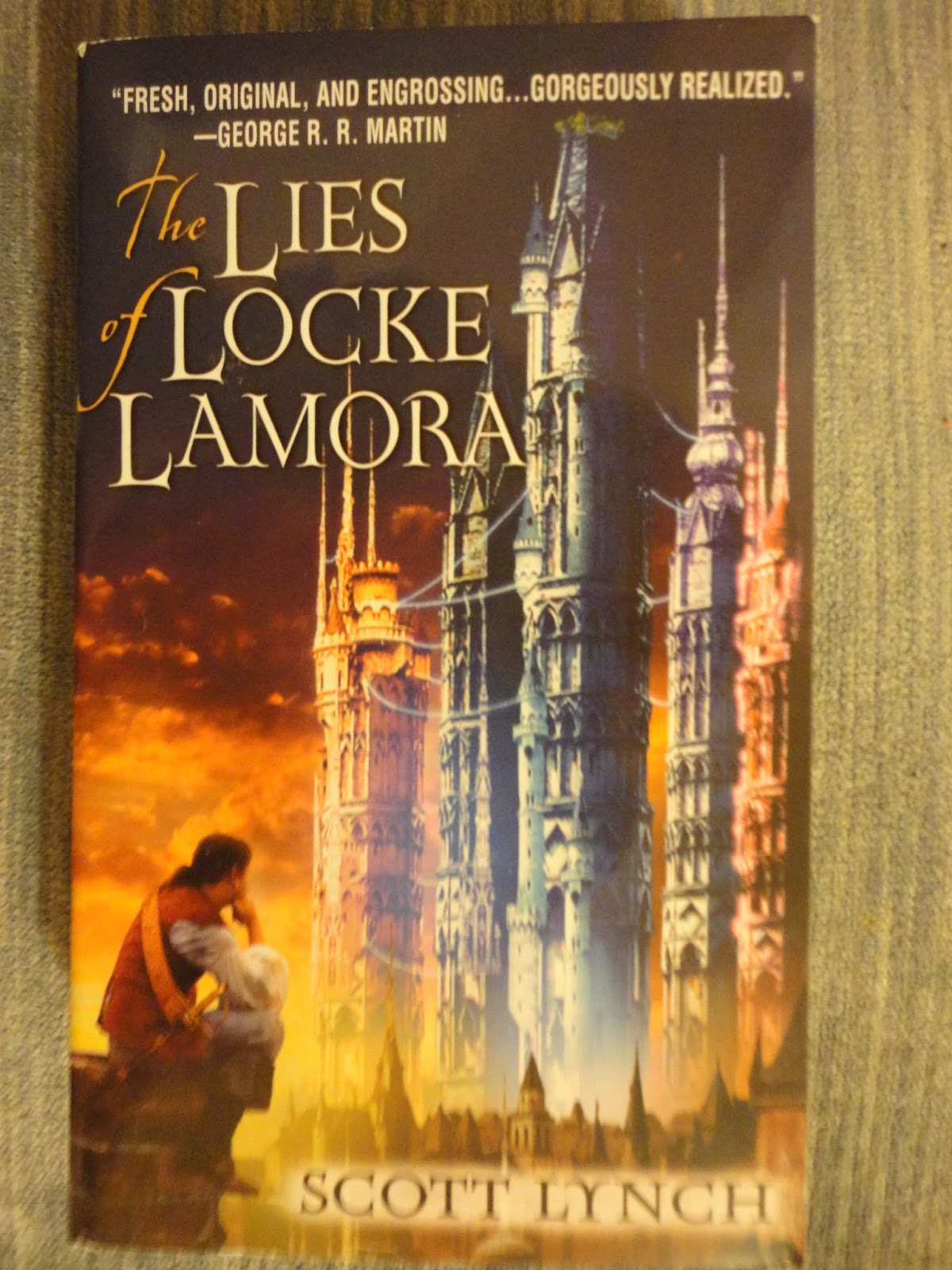
"The Lies of Locke Lamora (Gentleman Bastard #1)" by Scott Lynch

I finally finished this book. I've tried reading this twice before in the two years I've owned it, and it was on my list of the 5 books I hoped to read in 2015, so I have to say it's a relief to finally know what exactly people are talking about when they mention The Lies of Locke Lamora.

The pacing on this book takes a bit of patience on the part of the reader. At some parts of the book I was utterly riveted. At others, I was zoning out, thinking of all my nefarious ancestors and their own misdeeds, rather than actually reading. I must say this was well worth finally finishing, but it isn't as quick and easy to devour as some other books.

The Plot: (As Seen on Goodreads)
'In this stunning debut, Scott Lynch delivers the thrilling tale of an audacious criminal and his tightly knit band of tricksters. Set in a fantastic city pulsing with the lives of decadent nobles and daring thieves, here is a story of adventure, loyalty, and survival that is one part "Robin Hood," one part Ocean's Eleven, and entirely enthralling....
'An orphan's life is harsh--and often short--in the mysterious island city of Camorr. But young Locke Lamora dodges death and slavery, becoming a thief under the tutelage of a gifted con artist. As leader of the band of light-fingered brothers known as the Gentleman Bastards, Locke is soon infamous, fooling even the underworld's most feared ruler. But in the shadows lurks someone still more ambitious and deadly.
'Faced with a bloody coup that threatens to destroy everyone and everything that holds meaning in his mercenary life, Locke vows to beat the enemy at his own brutal game--or die trying....'

The strengths of The Lies of Locke Lamora lie mostly in the worldbuilding and characters. I was continually amazed at the amount of detail going into the world, either via magics, gods, or structures (not made by man). The characters are what kept me reading, even when I was a bit bored with the plot. Locke, Jean, Calo, Galdo, and Bug are a dynamic team of personalities that (mostly) follow Locke's lead.

The plot suffered from over-segmentation. I like little things- I have a Dorkie who is half the size of my cat, but I don't like minced stories with so many little vignettes. Every time I saw a double space with a number between it I grimaced, because I knew it was either A) unnecessary or B) another scene that I'd have to adapt to, before being flung into the next little mincemeat pie of paragraphs. It annoyed me to no end. You'd think with little chunks of chapters, this book would be fast-paced, but to me it came off as choppy.

The Lies of Locke Lamora reminds me of a serialized Victorian story- there are a lot of little sections of text within each chapter. This style might appeal to other people, but not me. Although this book is certainly excellent, it would have been more palatable to me to have a few of those little segments strewn together to make it more cohesive. Nonetheless, I recommend The Lies of Locke Lamora to those who love stories about orphan thieves stuck in a fascinating fantasy land.

Rating: 4 of 5 Stars for an excellent fantasy that was a little too minced for my taste.


Content: Ages 16+ for violence, swearing (like a den of thieves), and brief sexual content.


Page Count: 719 pages in my mass market paperback edition

I read-a-long with the Snowflakes and Spider Silk's Gentleman Bastards (Re)Readalong, but alas, I finished early due to other commitments.

Saturday, May 9, 2015

"Neverwhere" by Neil Gaiman

Torrie is not keen on being the Neverwhere cover model.
Sometimes I feel like I'm reading the same novel of Mr. Gaiman's over and over again. To date, I've read three of his books, including this one, American Gods, and Stardust, and increasingly I'm finding the same characters... only all the books I just mentioned aren't supposed to crossover. Sure, there's a couple characters that are different (and even diverse, which is great), but... I have yet to be convinced I'm reading something new, something I've been looking for in a Gaiman novel, some kind of connection with the characters, something to make me feel sad that the novel has ended, and there isn't a second volume for me to pick up.

This book I was excited about because I like the idea of portals to other realms, and this book's covers suggest the plot would center around that idea. In fact, I was so excited to read this book (and convinced it would be my favorite Gaiman yet) that I bought a mass market paperback copy to read in addition to my digital edition.

The Plot:
Richard Mayhew stops to assist a damsel in distress, only to be erased from his own world and dumped in a world he never knew existed before. The damsel, Door, is being hunted by mercenaries, but will she be able to find who's behind the deaths of her family members before she herself is found?

Richard Mayhew may not be a lookalike of Shadow (American Gods) and Tristran (Stardust), but I can't help but feeling they all have the same soul. I admit disliking characters who don't know what exactly they're after, but usually I find something about them endearing, and in Richard's case, it was his love of troll dolls. Beyond that, I was a bit bored with him because of his soul/personality similarities to Tristran and Shadow, and Mr. Gaiman's consistent use of making them into heroes via the story of the book. I'm a bit over the everyman-becomes-"the-man" plotline: I saw it coming here, but hoped I was mistaken that the author would roll it out again. Not a spoiler, but he did.

While I did like the world it was set in, and some of the side characters (Hunter was particularly exceptional), I was hoping for a little more surprise in the ending. With Stardust, even when I'd seen the movie (and thus the basic plot), Mr. Gaiman surprised me with a different ending than I'd anticipated. With Neverwhere, you pretty much know how it will end, and so when it ends, you kind of wonder why you bought that mass market paperback, even though it was less than a quarter the cost of a good potting soil.

Neverwhere was underwhelming for me. Although I love quests, sometimes I'd like more than a few twists tossed in for good measure, in addition to main characters who are more interesting than the side ones, and probably some villains who don't remind one of Charlie Chaplin and Ozzie Osbourne's love children (who went on a few too many bad trips, became assassins, and somehow became the best at torture and general mayhem). If you love Mr. Gaiman, Neverwhere will probably only add to your love of Mr. Gaiman, but if you're lukewarm about some of his main characters, like me, you might find Richard Mayhew a little too familiar.

Rating: 3 of 5 Stars for a good story that I was hoping would be different.


Content: Ages 16+ for graphic violence and occasional swearing.


Page Count: 370 pages in my mass market paperback edition

Thursday, April 23, 2015

"Turtle Moon" by Alice Hoffman

I generally dislike anything contemporary, but in the case of Alice Hoffman novels, I love it. She's well-known for her use of magical realism, taking fantastic elements and weaving them into the plot of something set in our world, without the 'start-from-scratch' world building of urban fantasy.

In the case of this novel, most of the magical realism elements are set around the human connection to animals, and the chaos around month of May that takes over the small town of Verity, Florida every year. Verity is newly inundated with single mothers, due to the low cost of living and the scenery. Even though it seems a relatively placid place to live, the month of May brings about drastic changes in the town.

The Plot:
When the meanest boy in Verity, Florida, Keith, runs away with an orphaned baby girl whose mother has been murdered, his mother Lucy refuses to believe he's guilty of the crime, even when evidence suggests otherwise. Julian Cash, who is a specialist with Verity's canine police unit, uses his dogs to dig up clues to Keith's whereabouts, but will the murderer be found in time?

Animals always seem to crop up in Alice Hoffman's books, whether it's the doves of The Dovekeepers, the horses of The Foretelling, or the wolves of Second Nature. In this book, the main theme is dogs, although a gator does pop up in the course of the story. Julian has two dogs he uses to track suspects: Loretta, a relatively well-behaved shepherd, and Arrow, a semi-feral "air dog" whose nose can track anything rotten, even long-dead things. Arrow forms a special connection with one of the characters late in the book, proving although he won't let anyone else touch him, he isn't as rabid as he seems.

We also get to see the other side of a relative ne'er-do-well, Keith, and his grown-up equivalent, Julian. Keith seems to get into more trouble when he moves to Verity, pining for New York, where his father lives, instead of the smothering heat of Florida. Julian is a man of few words when the book begins, but subtle changes take place in his life throughout the book. He has many things he's done wrong in life and realizes that, but sticks relatively to the straight and narrow path as this book plays out.

My favorite quote:

"But doing the right thing doesn't mean you can sleep at night. It doesn't mean you won't regret it for the rest of your life."


      ~Turtle Moon by Alice Hoffman, page 238

Turtle Moon has every element I love about Alice Hoffman's novels: animals, a small town setting, and genuine human beings as characters. Although I would have liked to see a little more about a certain angel that haunts a tree in town, it really couldn't have been a much better read for me. If you like contemporary, but aren't afraid of mixing it up with a little suspense and fantastical elements, you should consider giving Turtle Moon a try.

Rating: 4.5 of 5 Stars for an exceptional portrait of a town called Verity!


Content: Ages 16+ for non-graphic sex scenes, violence, Diet Dr. Pepper-addicted divorcees, and one loyal dog.


Page Count: 255 pages in my hardcover edition.

Thursday, March 5, 2015

"Moxyland" by Lauren Beukes

In a land of ubiquitous jargon...

I picked up this ebook from my invisible-pile because I've been seriously slacking in my Sci-fi reviews. Also, the cover was cute and I thought it was pretty non-threatening to pick up.

By my ubiquitous jargon comment, I mean the words and slang can be fairly hard to decipher at first. Most of the complex ones are explained, but there are several words of which I still have no freaking idea what was meant by them, or what combo of words they were meant to be. Even though its frustrating to trudge through at first, a lot of the slang grows on you and becomes one of the signature and (dare I say it?) fun parts of the book to read.

The Plot: (As Seen on Goodreads)
'A frighteningly persuasive, high-tech fable, this novel follows the lives of four narrators living in an alternative futuristic Cape Town, South Africa. Kendra, an art-school dropout, brands herself for a nanotech marketing program; Lerato, an ambitious AIDS baby, plots to defect from her corporate employers; Tendeka, a hot-headed activist, is becoming increasingly rabid; and Toby, a roguish blogger, discovers that the video games he plays for cash are much more than they seem. On a collision course that will rewire their lives, this story crackles with bold and infectious ideas, connecting a ruthless corporate-apartheid government with video games, biotech attack dogs, slippery online identities, a township soccer school, shocking cell phones, addictive branding, and genetically modified art. Taking hedonistic trends in society to their ultimate conclusions, this tale paints anything but a forecasted utopia, satirically undermining the reified idea of progress as society's white knight.'

The characters in this book were interesting, but slightly stereotypical. Most reminded me of exaggerated caricatures of people I knew: although the characters were realistic, they weren't fully fleshed out. My favorite by far was the artist-type and "sponsor baby" Kendra, who made several interesting observations about photography and life in general. However, she was a little bit of a drifter- not that she moved a lot or anything like that, but she's one of those people who sort of just drift through life making questionable choices and reaping those oh-so-lovely rewards.

The best (and most surprising) part of this book was the gaming aspects. As a gamer, I've taken offence to certain renditions of the future because the gaming tech they described is already in effect and is virtually no different from now. This book, while originally published in 2008, presented a more plausible gaming environment: barcades with 'game wombs', age-specific gaming worlds (Moxyland is for cutthroat kids, people), and real-life situational/immersive 'gaming' in which the game companies come up with real-life operations for gamers to fulfill (with paint guns instead of real guns).

A funny thing about this book is the dystopia parts sneak up on you. Most of the book, you knew Big Brother was watching all the characters but thought 'Hey, that's not too bad- no child murders are going down on the sideline'. Sure, it had hallmarks of dystopia, but it wasn't that bad. Then you read to about 70% and your opinions on the matter drastically change, while in a waiting room where you suddenly slump in your seat and try to hide your ereader screen from innocent bystanders who happened to sit beside you.

The ending, for me, was where it went wrong. Some books it seems like you're happily reading along, waiting to read a nice epilogue or extra chapter, but suddenly you run out of pages, and the last 3% of the book you thought was part of the story is actually acknowledgements and other filler. What made it almost okay with me was a section where she returned to write of the inventions similar to ones in her book that have been made (or suggested) in the years after it was published. Some of it was scary- I don't want 2018 to have police states like this!

Moxyland is a haunting glimpse at a possible dystopic near-future that you almost feel is possible. The key word is almost. I don't think we'll advance this far by 2018, but I will gladly eat my words and wear a BabyStrange (a jacket with screens/cameras embedded in it) while livestreaming an apology tour on my recently appropriated vlog if I am proven wrong. Nonetheless, this read was solid entertainment, even if the characters didn't really make their mark on me (other than dearest Kendra). If you're a fan of dystopia that sneaks up and smacks you in the face, filled with jargon that's a bit difficult to dive into at first, I recommend Moxyland for you.

Rating: 3.5 of 5 Stars for a great dystopia with a jarring ending.


Content: Ages 18+ for a rather scary dystopia (violence, swearing, drug and sexual content).


Page Count: 384 pages in the ebook version.

Thursday, February 19, 2015

"Written in Red (The Others #1)" by Anne Bishop

I have a few things I must express my opinion on before I can carry on with this review:

1. This book should have had a Wolf puppy in a harness on the cover- there is absolutely no reason to not have a wolf puppy on the cover, as I would have bought this book when it was first published, had it had an adorable Wolf puppy in a harness on the cover. Like so:


2. The subtitle should include that it does, in fact, feature a harnessed Wolf puppy- just in case the harnessed wolf puppy on the cover was mistaken for a miniature schipperke kelpie cross spotting a mouse while on her walk or mini direwolf à la A Song of Ice and Fire series.

3. Cutesy pawprints are entirely optional- but strongly suggested. Just in case someone took this book cover mockup too seriously.

I don't always reassign published books cover art, but when I do, it means I liked the book enough to take time to make my fan art. And in the case of this book, I really liked it.

The Plot: (As Seen on Goodreads)
'As a cassandra sangue, or blood prophet, Meg Corbyn can see the future when her skin is cut—a gift that feels more like a curse. Meg’s Controller keeps her enslaved so he can have full access to her visions. But when she escapes, the only safe place Meg can hide is at the Lakeside Courtyard—a business district operated by the Others.
'Shape-shifter Simon Wolfgard is reluctant to hire the stranger who inquires about the Human Liaison job. First, he senses she’s keeping a secret, and second, she doesn’t smell like human prey. Yet a stronger instinct propels him to give Meg the job. And when he learns the truth about Meg and that she’s wanted by the government, he’ll have to decide if she’s worth the fight between humans and the Others that will surely follow.'

What the author knocked out of the park: the worldbuilding, the characters, and the quotability. It isn't often you start a book where there is a section to tell you the name of certain days of the week (instead of Monday, Tuesday, etc.), along with a brief history of the world itself. The characters made you want to hunt down real life people to match with their personalities, so you could have your own mini-Courtyard/fantasy world. The quotability? Well, I highlighted the hell out of my ereader. My touchscreen is still recovering from me spouting curses as I tried to nab those difficult, between-two-page-flips quotes.

Believe it or not, I've had similar conversations before:

""Your first dog?" The clerk sounded delighted. "What breed is it?"
""He's a Wolf.""

         ~Written in Red by Anne Bishop, page 206 Kindle version.

Although Meg breaks the urban fantasy heroine mold by being not-so-brave (she squeaks and whines under pressure), she grew on me, to the point she satisfied the requirements of being a heroine I love. I was very worried about this book because it features the heroine cutting (due to her being a blood prophet)- a self-harm behavior I'd hate to see encouraged, even in a fantasy book. But the other characters don't approve of Meg's cutting, and she only cuts on purpose maybe twice in the course of the book, which the Others chew her out for (or should I say Simon?).

Written in Red is a book about a harnessed wolf puppy urban fantasy that stands out because of its exceptional world and characters. From the cover, I had expected something a little bit darker, which it kind of was, but not to the extent I restrained myself from laughing out loud in a quiet waiting room. If you're looking for an urban fantasy that only hints the faintest whiff of paranormal romance (despite having a female main character), I recommend Written in Red for you.

Rating: 4.5 of 5 Stars for a urban fantasy that surprised me with its humor.


Content: Ages 16+ for cutting, violence, and angry Wolves.


Page Count: 433 pages

But really, which one would you pick: adorable harnessed Wolf puppy or Meg and menacing wolf?


Don't tell me- I don't want the cover artist to feel bad. :P
Related Posts Plugin for WordPress, Blogger...